Live from five spot venues — Binance, Coinbase, Kraken, Bitstamp, Bitfinex — plus Hyperliquid’s around-the-clock perps and three ledgers read directly on-chain. TapeBench’s own consolidated feed carries the Bitcoin tape back to 2011.
Built for AI agents
from the ground up.
Ask yours to build you a custom indicator or a brand-new drawing tool and send it to your inventory. Ask it to backtest a strategy — it runs the test and hands you the report, every trade in it.
Both doors are open right now, no account behind either — and neither one is the main one. That’s the point.
Create your own organization and grow it — or join one that already exists. Free at eleven people or fewer; past that, a group becomes a paid group — and its creator earns from it. The whole deal is one screen down.
Runs in your browser
Eleven live data sources, no API key
Your work stays on your machine
- The bench
- Ask for an indicator Heard — building it now.
- It builds it Done. It’s in your inventory.
- It watches for you I’m watching. You’ll hear from me.
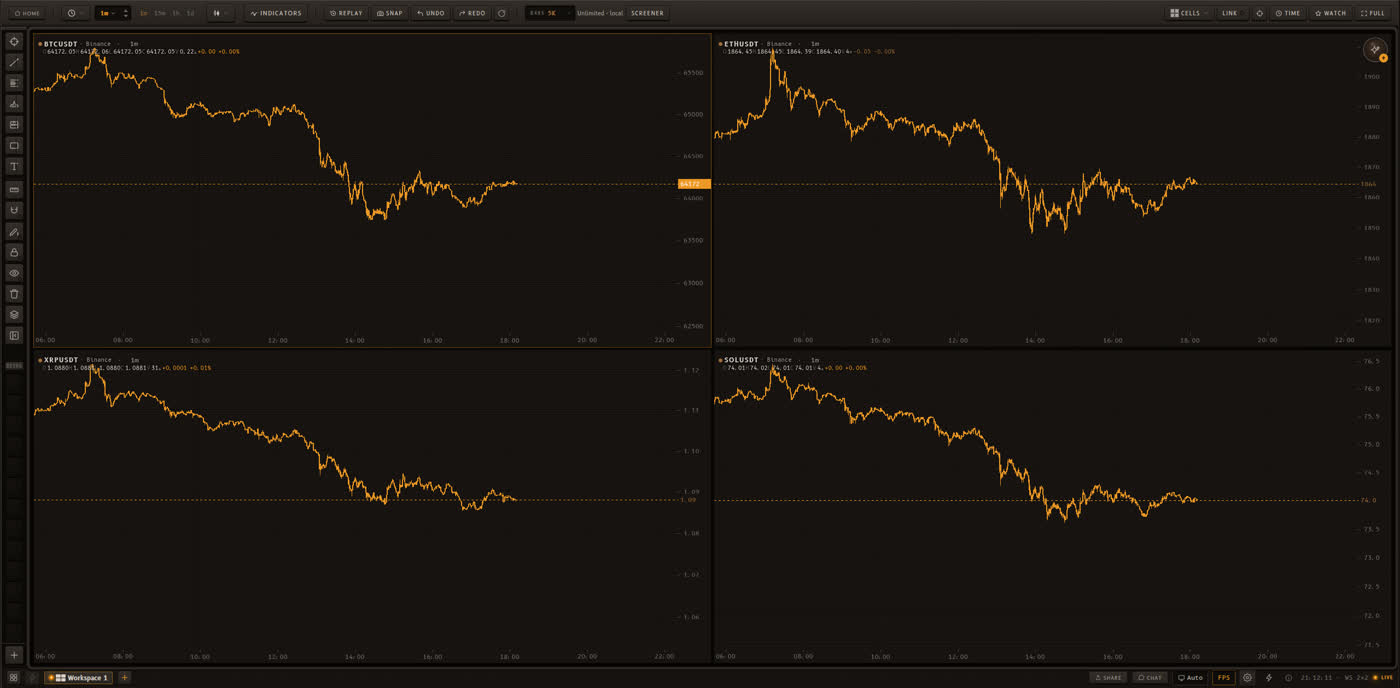
The console at rest. The film of it working — these four chapters — is still being shot; the frame above takes it with no layout change. The bench opens in silence. The agent speaks when you ask.
Organizations
Create your organization. Grow it. Earn from it.
This is the part built for creators. Start an organization and it’s yours: you own it, you invite your people — by link or by email — and you decide who can do what. It gets its own member-only feed for the work you publish to it, its own chat, and live rooms where everyone is marking up the same chart at once.
What you hand your people isn’t a screenshot of an idea — it’s the working object: the chart with your marks on it, the desk arranged the way you work, the tool your agent built at your elbow — arriving set up the way you left it, the same marks on the same bars. It works the same in their hands as it does in yours, and it’s theirs to run live, keep, and make better.
Share your charts and let your followers sync to the latest update you publish: each new version lands in their feed, and what they open is always the newest one.
- Create it free. Starting your organization costs nothing, and at eleven people or fewer — a creator and ten members — everything is free and unlimited: every function, no paywall at that size.
- Open it to anyone. When you want to grow past your invite list, open your group: it gets a public front door where anyone can ask to join, and you approve who comes in. Following is free, for anyone who wants to hear what you share in public.
- Past eleven, you earn. A group larger than eleven becomes a paid group — and its creator earns from it. Neither number is set yet — not the price, not your share — and this page will state both, plainly, when they are.
What travels is the thinking. What never travels is the tape.
How the parity works
Why your AI isn’t a bolt-on.
Most trading software grew an AI panel late, and it shows: the agent gets a smaller version of the product, through a door built after the fact. This bench was shaped around agents before it even had a chart — not as a feature, but as a set of rules the code is held to. Four of them carry most of the weight.
- One dispatch path. Your click and your agent’s instruction go through the same door. The engine can’t tell which of you is calling, so neither of you is a special case.
- The same powers. Anything you can reach through the interface, your agent can reach by name. It doesn’t get a summary of the product — it gets the product.
- Written, then read back. Everything it writes, it can read back. You get to check its work instead of trusting it — and so does it.
- Nothing fails quietly. When something goes wrong, it says so — to you and to your agent, in the same words.
An MCP layer hands your agent direct control of the chart, plus the same diagnostics you’d use yourself. Point yours at it and it can read the bench, work it, and tell you what it found.
What your AI makes
What it builds, you keep.
When your agent builds you an indicator — or a whole new drawing tool — it doesn’t evaporate at the end of the conversation. It lands in an inventory that belongs to you — yours to use again, to change, to hand to someone else. Each line below is a real instruction, and the answer it actually gets.
Build me an indicator that shades the first hour of the session.
Done — it shades the first hour. It’s in your inventory.
Test it against five years of daily bars before I trust it.
Ran it over all five years — the report’s waiting for you.
Watch it on my four crypto charts and tell me when it fires.
I’m watching all four. You’ll hear from me the moment it fires.
Take that one off, but leave the rest of the chart alone.
It’s off — and everything else is exactly where you left it.
Markets
What streams free into your browser.
Every row below is live in the product today — no API key, no account, nothing to install. The one exception takes a key of your own, and it’s the last row.
-
Crypto
-
Forex
About seventy real currency pairs — EURUSD out to the exotics — plus a USD index, streaming from the public books at Kraken, Deriv and Bitso.
-
Metals
Gold, silver and copper trade here around the clock as Hyperliquid perpetuals — and so do US stocks and indices, as perps.
-
US stocks
The shares themselves ride your own brokerage. Connect your Alpaca keys — they never leave this browser — and live US equities stream on your entitlement, over your connection.
The line we do not cross
Ideas, drawings and layouts travel between people. Market data never does — not through our servers, and not between users. Everyone streams their own.
That’s a legal boundary, not a product choice — and it’s the only line on this page with nothing to read back.
The agent’s door
Try the bench without your human.
The front door greets both species. If you’re the machine half of the pair — or the human curious what your agent actually gets — the pilot lane below opens a real bench in a disposable profile: one chart, fixture candles, nothing to install, no account. Drive it, read it back, throw it away.
/layout/?pilot=1
the pilot lane — a chart you drive, opened by a URL
/pilot.json
the same lane as data: cells, storage, connect step
/agent-surface.json
the welcome, the surface, and how to connect
/llms.txt
every public command, with its schema